
Beginning this academic semester, Yavapai County became the first in the state to start a new phonics-based teaching initiative — with financial support from the county.
County School Superintendent Steve King [R] said The Science of Reading initiative, focuses on moving away from “whole language” learning, which involves learning through “predictive text” models like SRA textbooks or Dick and Jane books.
“Instead of using phonics to learn how to decode the parts of the word, it’s more of a memorization,” Cottonwood-Oak Creek School District Director of Curriculum Jamie Woodward said.
Phonics, instead, is using instruction to understand the oral, spoken parts of language and then connecting that to the letter symbol later. She used the example of the word “cat.” The “C” has its own sound, the “A” has a different sound and the “T” has its own sound.
Children will learn these different sounds in preschool and kindergarten and at home and will later be able to connect that to the symbol for each letter.
“What’s come out nationally is that since probably the 1940s, we have had the research that phonics instruction is truly the foundation of learning to read,” Woodward said. “Unfortunately, there was really a movement around ‘whole language’ that was not built on solid research that came to the forefront in the United States.”
Part of phonics instruction needs to be included in other subjects as well, she said, to make sure students can understand everything.
“Students need to have broad awareness of the world that we live in,” Woodward said. “They need to have science, history, geography, all of those pieces as well in order to eventually become adults who are strong readers, have strong comprehension, strong writing.”
King, the former COCSD superintendent, said the district has been beginning to implement this over the past five years, and wants to see it at the rest of the school districts in the county.
Across the Verde Valley
Arizona is 49th in education funding. King said because education is crucial for younger children, they need to ensure incoming students get the best education as soon as they enter public school.
“We … can’t do anything about preschool,” King said. “I have no resources for preschool. Arizona has very, very little commitment [to preschool].” To make positive changes, King said, the school districts and the county overall need to be active about advancing instruction, especially in kindergarten and first grade.
“There’s wonderful things happening in every single district,” Woodward said. “… Can we create a time where people get together, and they really share and look at what are the evidence-based practices that are really working? … Because Camp Verde School District does not look identical to Cottonwood. And so we get together, we talk about what works, we talk about how their system is similar and different, and then they make that work in their district,” and vice versa.
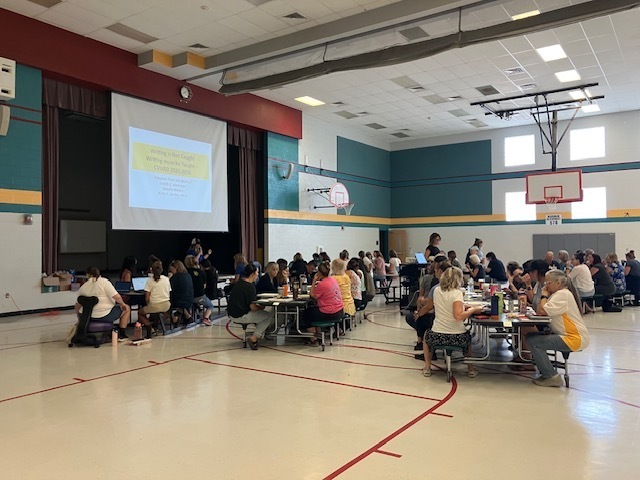
The first science of reading training for teachers happened in Camp Verde on Aug. 22.
“So you’re a teacher, and your boss tells you you have to attend a training,” said Yavapai County Superintendent Nikki Check [D-District 3], who attended the meeting. “What I noticed was a room full of teachers who were enthusiastic and excited to take in this new information.”
Language Essentials for Teachers of Reading and Spelling trainers help teachers learn how to implement the science of reading into classrooms and give the teachers literacy endorsements, required by state law for every teacher.

“A literacy endorsement requires a whole bunch of hours of training,” King said. “You got to go through this and it’s expensive. It costs money, so you’re putting an additional burden on the teachers as far as finances go, and they’re mandating that you have to do it. So if you want to bring a LETRS trainer up from Phoenix, it’s expensive.”
Yavapai County initiative’s plans its use own LETRS trainers — currently numbering five — to ease the financial burden as well.
“In Arizona, especially in rural Arizona, public schools struggle and due to funding,” Check said. “We’ve seen several public schools close over the years, including Big Park and so Yavapai County and the superintendent’s office — we can’t move the financial needle as much as we would want to, of course, and so I really appreciate superintendent King’s desire to just make our school systems better no matter what funding looks like.”
Yavapai County
Originally, King wanted to have a county-wide position that could organize these changes, but after the board of supervisors struck that from the budget, he advocated at budget hearings in April and May to ask for funding, such as far letter training instructors.
“It’s a three-year proposal; $100,000 a year to be used at the discretion of the county school superintendent,” King said during a presentation to the board. “To propagate, expand and embed The Science of Reading across this entire county to further the reading and literacy of our children in this county. It would also come with a yearly report by me, and a review by the county supervisors to say ‘yes or no, are we showing progress or not?’”
During the hearing, Check said a focus on early education prevents children from ending up in the legal system.
“There’s another layer to this which is economics,” she said. “I think part of the reason to consider having the county step in — if not this year, in future years — is that when people decide to move here for a job or to locate an industry, education often is one of the most important factors in people making that decision.”
The board passed the budget unanimously, including funding for King’s proposal, making it the only county in the state to fund education this broadly.
Schools’ Reactions
Since the budget passed, King said cross-district training sessions have begun in the Verde Valley.
Camp Verde School District Superintendent Steve Hicks said it will take a few years for this process to fully implement.
“With the Yavapai County Education Service Agency coordinating these trainings throughout Yavapai county, we build a collaborative network that helps each district become more efficient and effective for the good of our communities. We share resources, we share great ideas — all for the benefit of our students,” Hicks wrote in a recent email. “Kudos to Steve King and his team for making this happen.”
King touted COCSD Superintendent Jessica Vocca for spurring on the initiative.
“You won’t find a … superintendent anywhere that would have agreed to basically share the knowledge and the time of the resources of this district with every other district that surrounds her,” he said.
Check said her favorite part of the initiative is that the county supervisors didn’t do a study on a phonics initiative beforehand.
“The people elect their elected [officials] to have that leadership and that vision, and superintendent King saw what was needed, and we just got it done for $100,000 compared to if we had funded a study to understand how to better impact phonics, it would have probably cost us $200,000.”